Click here to schedule your first free consulting!
Senate Department for Economic Affairs, Energy, and Public Enterprises
EWM
EWM (from German "Ergebnis- und Wirkungsmonitoring") is an enterprise-grade data platform we created for the Senate Department for Economic Affairs, Energy, and Public Enterprises in Berlin. It tracks the use of funds for research and development and turns that dynamic data into decision‑ready insights, so policy‑makers know exactly where every euro goes and what impact it delivers.
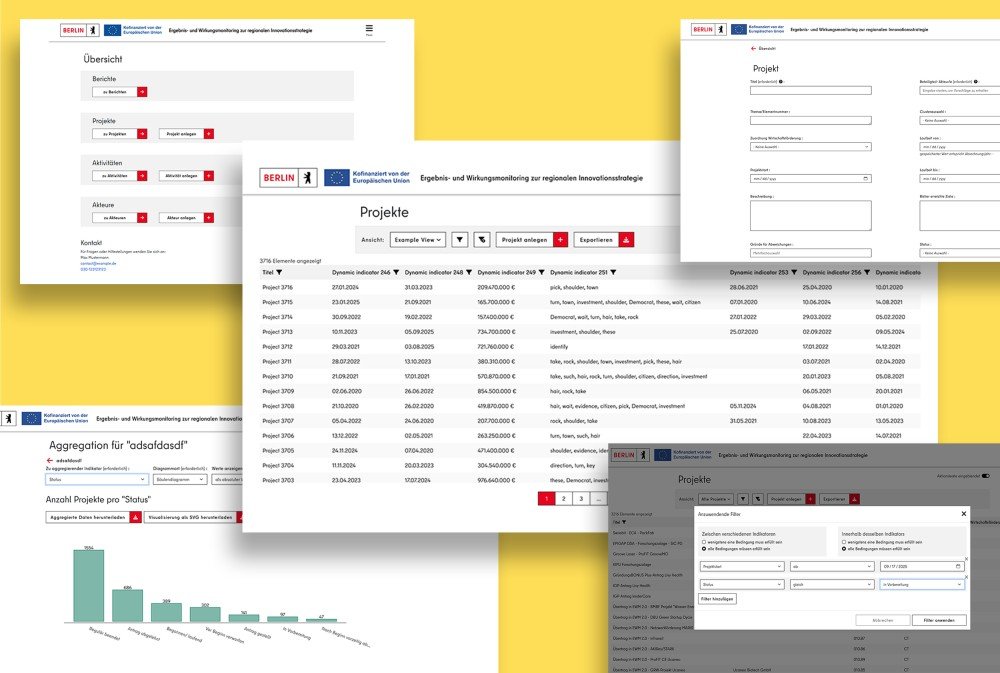
Flexible data management system that supports evolving data structures
Advanced filtering that supports dynamic fields
Granular field-based user permissions
Interactive fields for good user experience
Shareable data views for focused analysis
Customizable reporting and dynamic visualizations
Project description
The Senate Department for Economic Affairs, Energy & Public Enterprises steers Berlin’s innovation strategy and helps to secure multi‑million‑euro funding for companies across frontier sectors, from photonics and artificial intelligence to renewable energy and digital healthcare. To understand whether the money invested has an impact, they need answers to tough questions: which projects need additional support, where was funding successful, which sector is lacking or thriving, or even which activities sparked further projects?
We developed EWM to answer those questions at scale. As this requires the collection and analysis of large amounts of diverse, ever-changing data, we created a highly flexible data platform that adapts to both current and future data needs.
Because the structure of the data is not always fixed, we developed interactive input components to make data entry intuitive. One example is the dynamic controls that guide users to enter data, based on previous input, thereby simplifying complex dependencies.
Their reporting needs will also change over time as they are always improving how they measure and evaluate. Our shareable data views, customizable reports, visualizations, figures, and plots are built with this in mind. They enable users to redefine and focus on the data most relevant to them, helping Berlin Partner and Senate leaders track projects, activities, as well as actors and their impact across various sectors.
Challenges
The biggest challenge we liked was creating the flexible data framework. We had to store structures with any number of fields, each tied to the right data type, over multiple tables while still making aggregating over unique entries possible.
With the groundwork in place, we asked ourselves, how do we make flexible data structures user-friendly? It is not always clear to users how to input data and which data depends on other fields. To solve this, we created special interactive controls that adapt which fields are shown based on selections. The dependent fields are visually distinct and guide the user step-by-step, reducing mistakes, keeping the data consistent, and making the process intuitive.
Going further on user friendliness, we provided fields with additional features such as autocomplete, multiselect, field type differentiation, and help text, which keep the forms usable regardless of how complex the structure becomes.
To control data access, we introduced a granular field-based permission system that allows permissions to be applied at the field level, meaning that even within the same data structure, two users may see different fields depending on their roles. This gives administrators fine-grained control over who can view or edit specific information.
Finally, creating comprehensive reports was a very fun challenge since the data spanned multiple tables and had variable structures. We created advanced aggregations that supported grouping by any category field and informative visualizations. The result is a system that not only handles complex data but does so in a way that feels intuitive, secure, and efficient for every user.
Want to learn more
Data management for your growing business
In the digital age, the sheer volume of data available to businesses is overwhelming. Without effective data management, companies risk losing their competitive edge. How can you know if your strategies are working if you can’t measure them?
Euler
Euler puts you in control: centralize your data, secure it, and unlock insights that drive your project forward.
djangsters GmbH
Vogelsanger Straße 187
50825 Köln
Social Media

