Let's talk about your project.
An initial conversation — in person or online. You outline your plans, and we give you an honest assessment.
As a digitalization agency, we develop custom software based on Django and Python. We start with requirements engineering, not with code. The result is software precisely tailored to your company's processes and requirements.
For us, custom software development always means sustainable software development. That means designing and building software so that it meets the requirements of the present without compromising the possibilities of the future. It's not about writing perfect code, but code that holds up in everyday practice.
This is achieved through a clear architecture, understandable documentation, and consistent patterns. Automated tests are an important part of sustainability, as are technology decisions geared toward stability and continuity.
We have worked with organizations of various sizes, including government agencies and large enterprises, however, we particularly enjoy working with Mittelstand companies. Mittelstand companies are often highly specialized and have individual requirements that are not always covered by standard SaaS solutions. For that reason, they in particular benefit most from tailored solutions.
For Score Media Group, for example, which markets advertising in more than 420 regional daily newspapers, we developed PimScore. This product information management system automates the surveys that are sent to their network, as well as the distribution, the recording of responses, and conflict resolution, and then synchronizes all the data with Salesforce. Due to the enormous number of input fields per newspaper, placing all the fields on a single page would have impaired browser performance, while splitting them across multiple pages would have disrupted the workflow. The input system was designed so that it adapts to the process, instead of adapting the process to our software.
Together with Yourfirm GmbH & Co. KG, we built the site from a prototype into one of the leading job portals for Mittelstand companies, which has been running for over ten years. It started small and grew with every new feature, such as the SOLR-based search, the bidirectional Salesforce integration, and integrations with the German Federal Employment Agency, LinkedIn, and Xing. Mittelstand companies value continuity and pursue a long-term approach to operations, sustainability, and success. That aligns closely with our approach to software development.
SaaS platforms are built for broad markets, not for your company. Custom software is tailored to your terminology, your data, and your workflows, from the user interface to the business logic. When you have custom software developed, you own the software, are independent of external roadmaps and licensing models, and can adapt it as your company changes.
Public sector institutions often have requirements on which there can be no compromise. Sensitive data requires strict access controls and protective measures, on top of that, project requirements frequently change in parallel with legislation and regulation. The people who use the software are diverse, not all of them are technically savvy, some have disabilities, but all of them have to be able to do their work. Therefore, there is a stronger focus on security, accessibility, and usability.
For the Senate Department for Economic Affairs, Energy and Public Enterprises in Berlin, we developed EWM (Outcome and Impact Monitoring). This data platform records the use of research and development funds and prepares the results into decision-ready insights. Since the Senate Department is responsible for innovation funding for the state of Berlin, its data requirements are not standardized, we therefore implemented a user-friendly interface and matching evaluations, something that would have been hard to achieve without a tailored solution.
Together with the State Institute for Schools in Bremen, we developed ZAP, a web application that supports the state in conducting the 10th-grade final examinations. Since the application processes sensitive data, security and digital sovereignty are paramount. In addition, the system is used in everyday work by teachers and school administrations, not by IT specialists, which is why the interface had to be designed in such an accessible way that the work can be done without any training overhead.
Public-sector projects typically share this combination: strict control over the data and a clear commitment to making the software usable for everyone who has to work with it.
One of the biggest advantages of custom software lies in its precise fit. Instead of adapting processes to the limits of off-the-shelf software, individual solutions are developed around the company's workflows.

Tailored to processes and adaptable to changing business requirements.

Full control over business logic, workflows, and data management.

Custom software makes it possible to automate recurring processes quickly and precisely. External services such as AI agents can be seamlessly integrated.

Custom software can be connected directly with other systems and integrated into existing system landscapes.
The logistics industry brings different challenges than Mittelstand businesses do. In operations, many users work simultaneously, which is why data consistency across all systems is critical. Workflows depend on real-time tracking, and a part of the workforce, the drivers, works under conditions in which network connectivity is unreliable.
For Rhenus, we took over and extended an existing system, consisting of an ERP, a web-based dispatching application, and mobile apps that together coordinate the logistics of timber transport. The ERP is used by back-office employees and synchronizes data with the dispatching application. Through the dispatching application, dispatchers manage the pickups and deliveries of the timber transports. Through the mobile apps, drivers can accept orders, locate timber piles for pickup, and track the status of the transports, both online and offline.
The drivers are often on the road or deep in forests, where network connectivity is patchy or nonexistent. They still need full access to their data, and any changes they make have to synchronize later, as soon as they are back online. At the same time, tolerance for downtime is low, even a few hours of unavailability disrupts on-site operations. Logistics software must start from the assumption that work doesn't stand still, even when the network does.
SaaS solutions often appear cheaper at first glance, but their actual costs frequently remain hidden. Having custom software developed does involve higher initial costs, but these decrease over time, which can lead to lower total costs in the long run.
The hidden costs of SaaS become visible as the company grows. Subscription fees scale with team size or usage and thereby turn from a manageable expense into a substantial ongoing burden. On top of that comes dependence on the vendor's roadmap, on price adjustments, and on its continued existence, combined with limited customization options.
Custom software, by contrast, works like a long-term investment. The initial investment is higher, but you receive full ownership of the solution and can adapt it without restrictions. While subscription costs would keep accruing, custom-developed software pays for itself over time and delivers an ever better return the longer it is used.
Software projects rarely fail due to technology alone. Most failures can be traced back to unclear requirements, unrealistic expectations, or weak project processes. For a project to succeed, the risks of IT projects must be understood and actively minimized.
The counter-approach begins before the first commit. For us, agile development doesn't mean process for the sake of process, but rather short feedback cycles, early delivery, and continuous adaptation to what the project really needs. Requirements are clarified systematically, assumptions are documented, and decisions are recorded in a traceable way.
Continuous Integration and Continuous Deployment pipelines (CI/CD) ensure that every change is automatically built, tested, and deployable. Automated tests check code against real use cases. Regressions are caught early, not by the customer. Code is only considered finished when it has been proven to work.
Choosing the right agency determines whether these practices are actually lived in the project and thereby secures the long-term success of your project.
As an agency, we bring a full team: requirements engineering, project management, development, and QA, rather than a single freelancer's capacity. We work closely with our clients as genuine technical partners, not just service providers. From the very beginning, we focus on understanding your business goals, your challenges, and your long-term vision. Our collaboration is built on transparency and early communication, so that you always know what is being developed, why it is relevant, and how it fits with your goals, because the best results come from continuous feedback, not from late surprises.
We start with a joint kick-off and requirements workshops. After which, we work in two-week sprints. After each sprint, we show you the current status of the project on a test system(staging) and discuss the next steps. Before go-live, we do a final acceptance test, training sessions, and the handover of the technical documentation.
We use the Agile methodology specifically to pivot early if needed. At the start of each sprint, we plan which features will be worked on, meaning new or changed requirements can be incorporated into the next sprint without disrupting ongoing work. For larger changes, we discuss the trade-offs and adjust the project scope accordingly.
We use AI-supported tools (such as IDE assistants) pragmatically to speed up routine tasks and increase productivity. Since AI-generated code can be error-prone, human verification is mandatory. Every line of code goes through automated tests (pytest, jest), code linters (ruff, eslint), and a human review. Customer data is never transmitted to AI models in the process.
We structurally separate personal data into distinct tables in the database design to cleanly implement deletion deadlines and pseudonymization. All sensitive data is stored in encrypted form. Hosting takes place on European cloud infrastructure(e.g., Scalingo/SecNumCloud) in compliance with GDPR and ISO/IEC 27001.
We develop with usability in mind from the very beginning and in alignment with the BITV 2.0 and WCAG 2.2 (AA) standards. We continuously verify compliance through automated audits (e.g., Lighthouse).
After go-live, we offer a maintenance contract during which we take over the deployment of updates and monitoring. If an unplanned issue arises, we prepare a post-mortem analysis to ensure a sustainable resolution.
Here are a few projects we have implemented for Mittelstand companies that are currently in production.
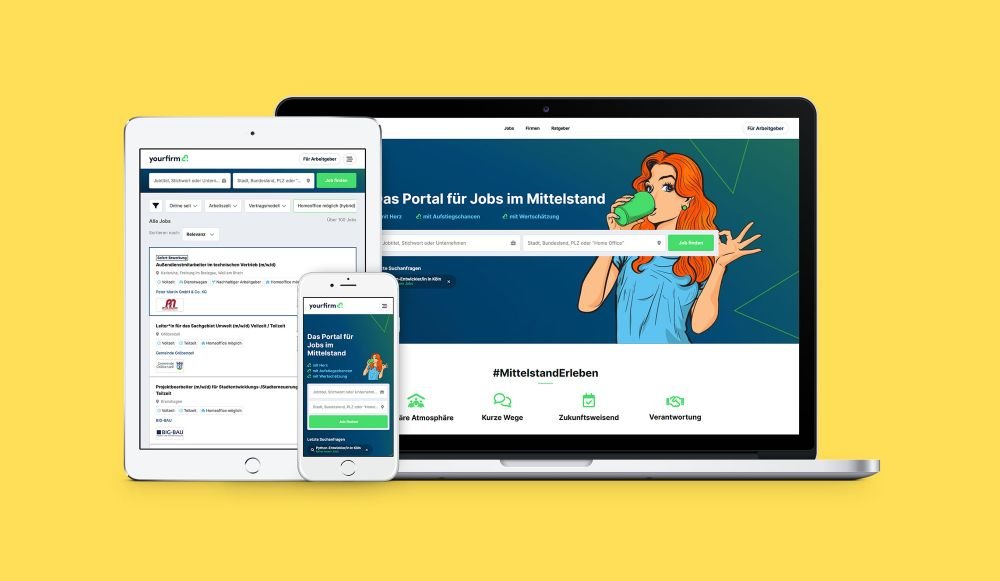
We developed a job portal for Yourfirm GmbH & Co. KG that connects professionals to opportunities at Mittelstand companies.
read more →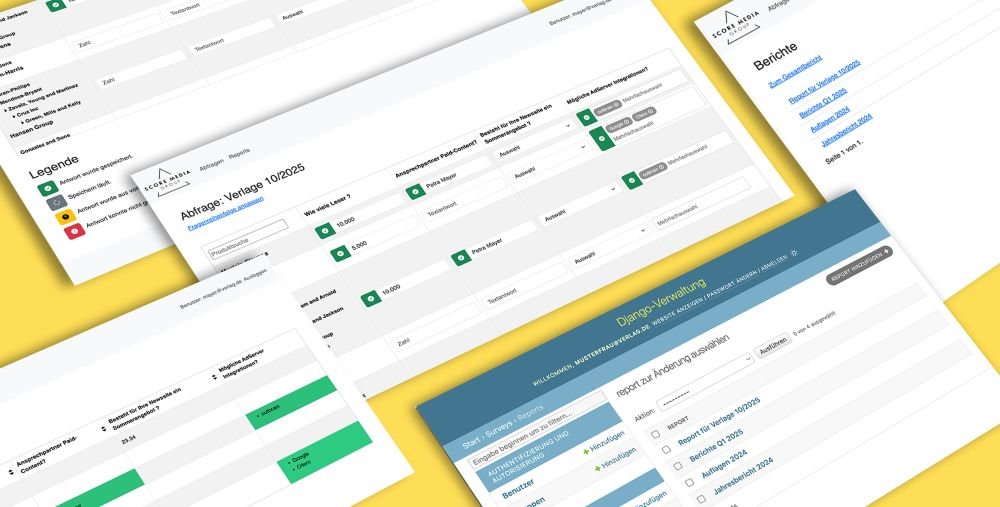
We developed a Product Information Management (PIM) solution for the Score Media Group that automates the process of distributing, capturing responses, and generating reports for the surveys they send to their network.
read more →An initial conversation — in person or online. You outline your plans, and we give you an honest assessment.
djangsters GmbH
Vogelsanger Straße 187
50825 Köln
Social Media

